Headless CMS and Jamstack:
The Future of Modern Web Development
The way websites are built and managed has changed dramatically over the last decade. Traditional content management systems (CMS) such as WordPress, Drupal, and Joomla have powered millions of websites by combining content management and website presentation into a single platform. While this approach worked well for many years, modern digital experiences demand greater flexibility, speed, security, and scalability.
Today’s businesses need to publish content across multiple channels, including websites, mobile applications, smart devices, digital kiosks, and social platforms. As customer expectations continue to rise, organizations are looking beyond traditional CMS platforms for solutions that can support Omni channel experiences and future growth.
This shift has led to the growing adoption of Headless CMS and Jamstack architecture, two technologies that are redefining modern web development. Together, they enable businesses to create high-performance websites, streamline content delivery, and improve user experiences while reducing infrastructure complexity.
In this article, we’ll explore what Headless CMS and Jamstack are, how they work together, their key benefits, and why they are increasingly becoming the preferred choice for developers, marketers, and business leaders alike.
What is a Headless CMS?
Headless CMS Definition
A Headless CMS is a content management system that separates content creation and storage from content presentation. To understand its power, let’s revisit its predecessor, the traditional CMS.
Think of a traditional CMS like a fully-assembled house. All the components—the wiring (backend), the interior design (frontend), and the plumbing (database)—are built together. It’s a complete package, but making changes to one part often requires reworking the entire structure. This “coupled” architecture limits you to the tools and templates the platform provides.
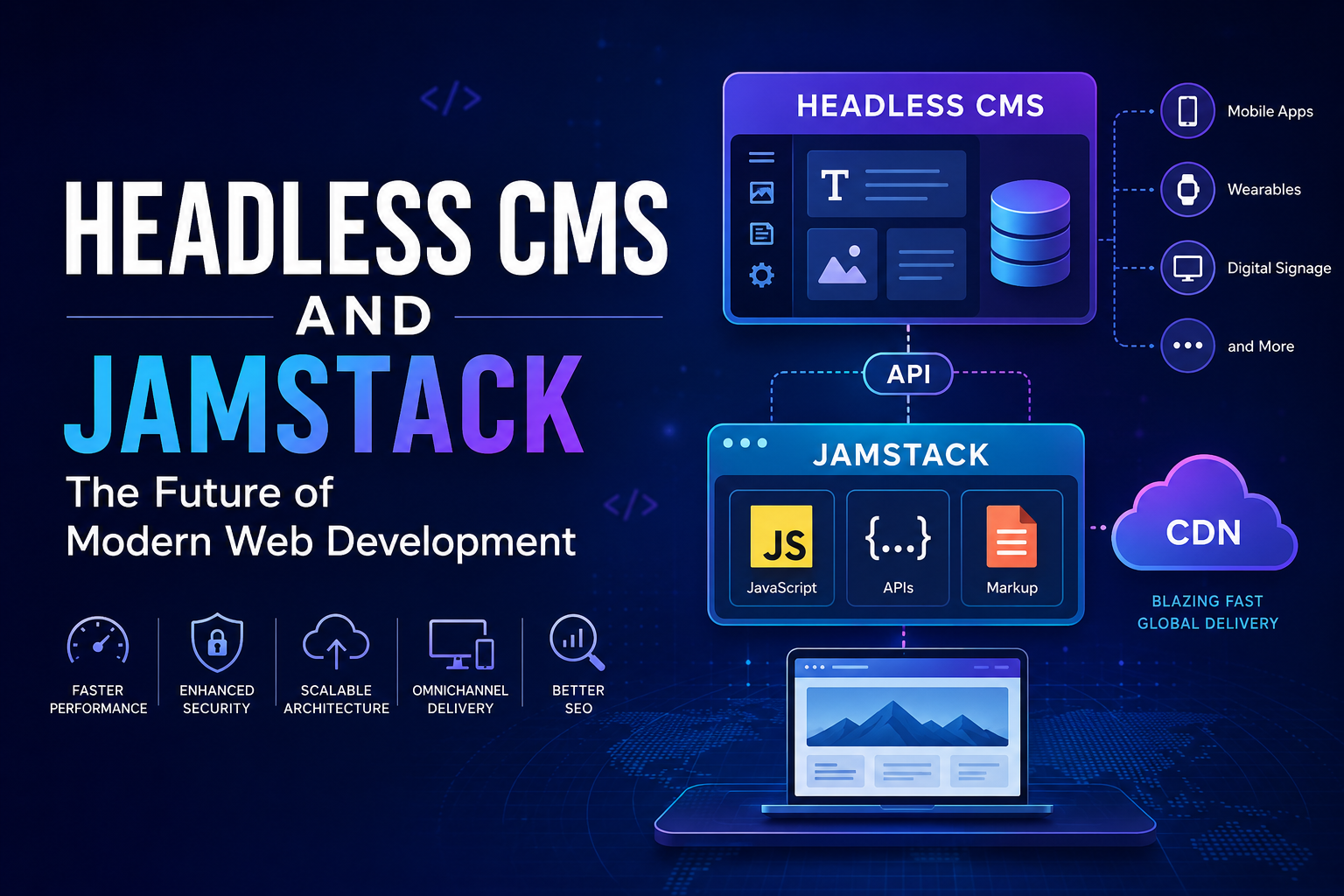
In simple terms, a Headless CMS is a backend-only content repository that stores and delivers content via an API. It has no “head”—meaning no built-in frontend, no theme system, and no assumptions about how your content should look.
- Content is created and stored in one place.
- APIs distribute the content wherever it’s needed.
- Developers can build any frontend experience using their preferred technologies.
2️⃣ Centralized storage
3️⃣ API delivery (REST/GraphQL)
4️⃣ Frontend apps display
Popular Headless CMS Platforms
Contentful
- API-first, robust SDKs
- Localization & workflows
Strapi
- Self-hosted, Node.js
- Full customization
Sanity
- Structured content
- Studio customizations
Storyblok
- Component-based
- Marketing-friendly
Hygraph
- Federated content
- High performance
Directus
- Instant API
- Data ownership
What is Jamstack?
Jamstack Definition
If a Headless CMS is the powerful engine, then Jamstack is a modern web development architecture that decouples the frontend from backend services and relies on pre-built pages, APIs, and client-side JavaScript. Instead of generating pages dynamically on a server for every request, Jamstack websites are often pre-rendered during the build process and served through a Content Delivery Network (CDN).
Jamstack isn’t a specific technology, but a modern web development architecture built on three core principles: JavaScript, APIs, and Markup.
- J – JavaScript: dynamic interactivity on the client side.
- A – APIs: server-side ops abstracted into reusable APIs.
- M – Markup: pre-built templated markup via SSG.
How Jamstack differs from traditional: Traditional websites often rely on server-side rendering + database queries per request, monolithic architecture. Jamstack replaces these with static generation, API-driven services, and global CDN delivery → faster, more secure, easier to scale.
How Headless CMS and Jamstack Work Together
They complement each other perfectly. Editors create content in Headless CMS → stored as structured data → delivered via APIs → frontend frameworks (React, Vue, Svelte, etc.) consume content & generate static pages → deploy to CDN.
📦 Content storage
🔌 API delivery (REST/GraphQL)
⚛️ Frontend rendering (SSG/SSR)
🌍 CDN deployment
Key Benefits of Headless CMS and Jamstack
Headless CMS vs Traditional CMS
| Feature | Headless CMS | Traditional CMS |
|---|---|---|
| Architecture | Decoupled backend/frontend | Monolithic |
| Performance | Extremely fast + CDN delivery | Server processing dependent |
| Flexibility | High frontend freedom | Limited by themes/templates |
| Security | Reduced attack surface | Plugin & server vulnerabilities |
| Scalability | Highly scalable (CDN) | Requires vertical/horizontal scaling |
| Content Delivery | API-based omnichannel | Primarily website-focused |
Popular Jamstack Frameworks
Next.js
- React ecosystem
- excellent SEO
Gatsby
- optimized images
- performance
Astro
- blazing fast
- multi-framework
Nuxt
- hybrid rendering
- great DX
SvelteKit
- fast UX
- simplified dev
Real-World Use Cases
Challenges & Considerations
🧠 Learning Curve – Teams may need API-first mindset and new tooling.
⚙️ Initial Setup Complexity – Requires frontend development and deployment pipelines vs traditional “install and theme”.
🔌 API Management – Governance, rate limits, authentication, and monitoring become essential.
👁️ Content Preview Limitations – Some platforms need custom preview environments for real-time editing.
💵 Development Costs – Higher upfront investment but lower long-term maintenance & infra.
Future Trends
Conclusion
The combination of Headless CMS and Jamstack architecture represents a significant evolution in modern web development. By separating content management from presentation layers, organizations gain greater flexibility, improved website performance, stronger security, and virtually unlimited scalability.
For developers, API-first CMS platforms provide the freedom to build with modern frameworks and tools. For marketers, they enable faster publishing workflows and omnichannel content delivery. For business leaders, they offer a future-ready foundation for growth, innovation, and exceptional customer experiences.
As digital expectations continue to rise, businesses that embrace Headless CMS and Jamstack solutions will be better positioned to deliver faster, more engaging, and more scalable online experiences. Now is the ideal time to evaluate whether a Headless CMS and Jamstack approach can help your organization improve performance, accelerate innovation, and create the next generation of digital experiences.