Here is an HTML document that creates a comprehensive, visually appealing guide to Core Web Vitals, styled with the Tailwind CSS library.
“`html
Google ranking factor · Page experience 2026
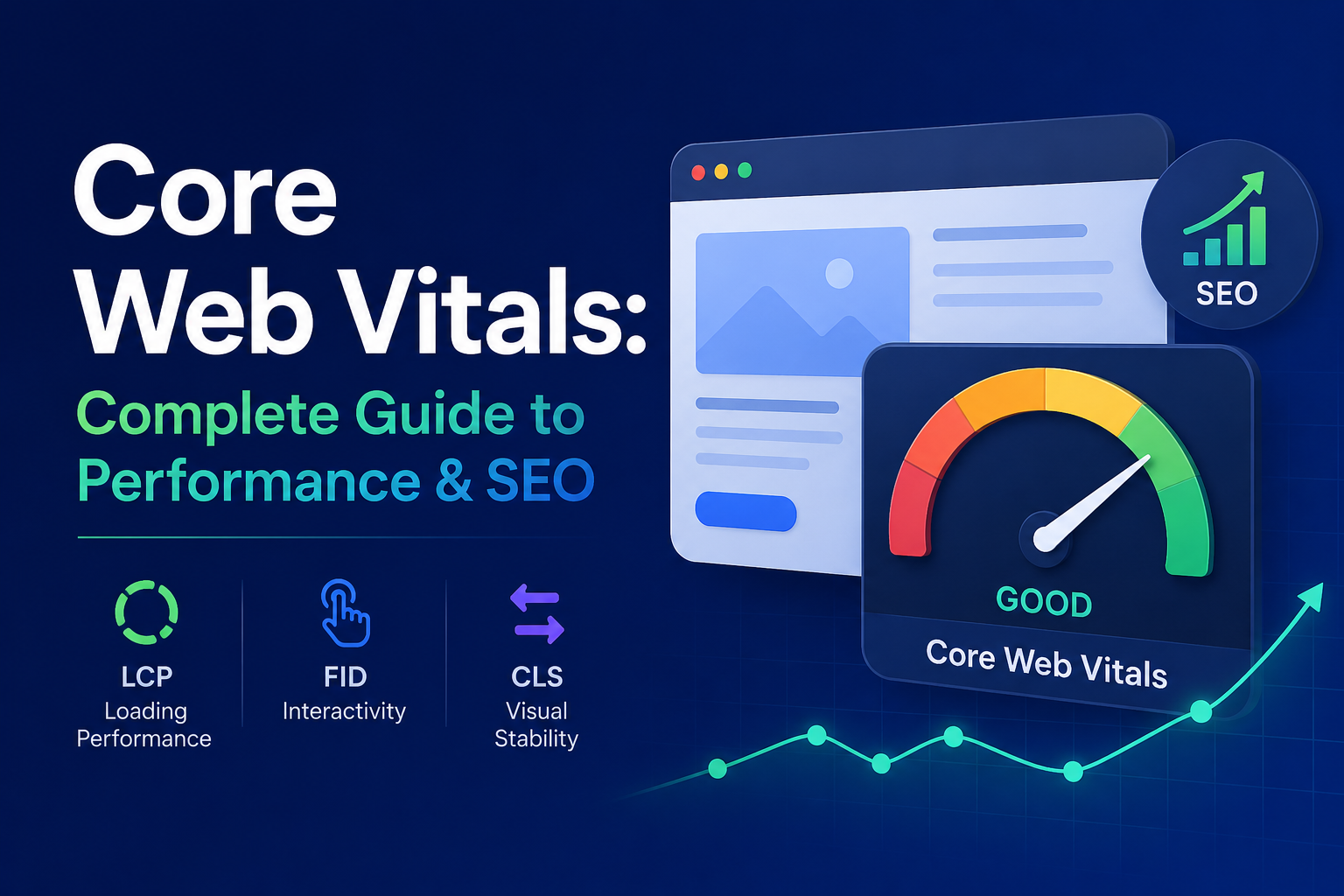
Core Web Vitals
Performance & SEO Guide
Fast, stable, and responsive websites win both users & rankings. Master LCP, INP, and CLS with actionable fixes, expert stats, and real-world wins.
Why Core Web Vitals define modern SEO
Web users expect blazing-fast, interruption-free experiences. If pages load slowly or shift unexpectedly, bounce rates skyrocket — and Google notices. Core Web Vitals are real-user metrics that quantify loading speed, interactivity, and visual stability. Optimizing them boosts engagement, conversions, and can give your site a ranking edge over slower competitors.[1]
lower abandonment
conversion drop per 1s delay
page experience tiebreaker
Google confirmed: page experience (including Core Web Vitals) is a ranking factor. When content quality is similar, faster & smoother sites win — but remember: CWV never overrides relevance. Pair great content with technical excellence.[2][3]
SEO + UX win-win
“Good Core Web Vitals are a foundation of sustainable organic growth.” — Google Search Central
75th percentile threshold: LCP ≤2.5s | INP ≤200ms | CLS ≤0.1
⚡ The three core metrics
Google measures real user experience through LCP (loading), INP (responsiveness) & CLS (stability). Hit these thresholds to delight users.
Largest Contentful Paint
Loading speed — main content visibility
The moment your hero image or main text block appears. LCP elements often dictate first impression. Actionable tip: preload LCP image, use fetchpriority="high", serve WebP/AVIF.
Interaction to Next Paint
Responsiveness — replaces FID (2024)
Measures delay between user interaction (click/tap) and visual feedback. Long JavaScript tasks are the main culprit. Fix: break up heavy scripts, defer third-party widgets, use web workers.
Cumulative Layout Shift
Visual stability — unexpected movements
Hate when buttons shift while you’re about to click? That’s CLS. Fix: always set width/height on images, reserve ad slots, use font-display: swap.
⚠️ Common performance pitfalls
- ✖ Massive uncompressed images (LCP killer)
- ✖ Render-blocking CSS/JS & zero code minification
- ✖ No dimension attributes → layout jank (CLS >0.3)
- ✖ Excessive third-party scripts: ads, chatbots, trackers
- ✖ Slow server response & no CDN caching
✅ Quick actionable fixes (SEO wins)
fetchpriority="high" for hero LCP.
🛠️ Best free tools to measure & debug
Leverage these to monitor field & lab data — from Google Search Console to WebPageTest.
| Tool | Best for | Free? |
|---|---|---|
| PageSpeed Insights | Real field + lab data, LCP/INP/CLS report & recommendations | ✅ Yes |
| Search Console (CWV report) | 28-day rolling CrUX data, URL-level performance | ✅ Yes |
| Lighthouse (DevTools) | Local debugging, performance scoring & synthetic audits | ✅ Yes |
| Web Vitals Chrome extension | Real-time LCP/INP/CLS while browsing | ✅ Yes |
| WebPageTest | Detailed waterfall, filmstrip & shift visualizer | ✅ Free tier |
🚀 WordPress performance playbook
WordPress powers 43% of the web – but often struggles with CWV. Apply these fixes:
- ✓ Managed hosting (Kinsta/WP Engine) + CDN (Cloudflare APO)
- ✓ Caching plugin: WP Rocket or LiteSpeed Cache – defer JS, minify CSS
- ✓ Image optimizer (ShortPixel, Imagify) auto-convert to WebP
- ✓ Disable unused scripts per page (Asset CleanUp) & limit heavy plugins
- ✓ Host Google Fonts locally & add preconnect + font-display: swap
“WP sites with LCP under 2.5s see 32% higher organic CTR on mobile” — Backlinko study
📊 Stats you need to know
🔮 The future of Core Web Vitals
Google continues to evolve metrics (FID → INP in 2024) and will likely keep refining user-centric signals. However, focus remains LCP, INP, and CLS — with mobile-first indexing making smartphone optimization essential. Prediction: interactions like smooth scrolling & navigation might be emphasized. But for 2026, mastering these three is the gold standard.
❓ Frequently asked questions
What are “good” thresholds for LCP, INP, CLS?
LCP ≤2.5 seconds, INP ≤200 milliseconds, CLS ≤0.1 (75th percentile of real users).
Do Core Web Vitals directly affect Google rankings?
Yes, as part of the page experience signal. Great content remains paramount, but with similar relevance, better CWV can outrank slower sites.
How often does Google update Core Web Vitals data?
Search Console refreshes every 28 days, using rolling window from Chrome UX Report. Improvements appear within weeks after fix.
How to improve INP on heavy JS apps?
Break long tasks (chunking), use `setTimeout` or scheduler.yield, move non-critical JS to idle callbacks, and reduce total blocking time.
🎯 Master Core Web Vitals = future-proof SEO
Faster sites win loyalty, engagement, and better visibility. Measure with PageSpeed Insights, optimize images, trim third-party scripts, and watch your user experience soar. Remember, it’s a continuous process — every millisecond counts.
Sources: Google Search Central, web.dev, Chrome UX Report, case studies by Vodafone & Tokopedia. Updated for 2026 guidelines.
“`