Siri AI and the On-Device Agent Era: How Apple Is Moving From Chatbots to Autonomous Assistants
Apple’s rebuilt assistant promises cross-app reasoning, local privacy, and agentic actions. But the real story is the partnership with Google Gemini — and what it means for the future of AI on your devices.
|
📍 Cupertino, CA
|
⏱️ 14 min read
|
🔗 siri-ai-on-device-agent-era
For the last few years, the AI conversation has centered on chatbots: models that write, code, and answer questions with increasing fluency. The next phase of that conversation is about assistants that act — booking a reservation, cross-referencing a calendar, drafting a reply in an existing thread — with as little of your data as possible leaving your device.
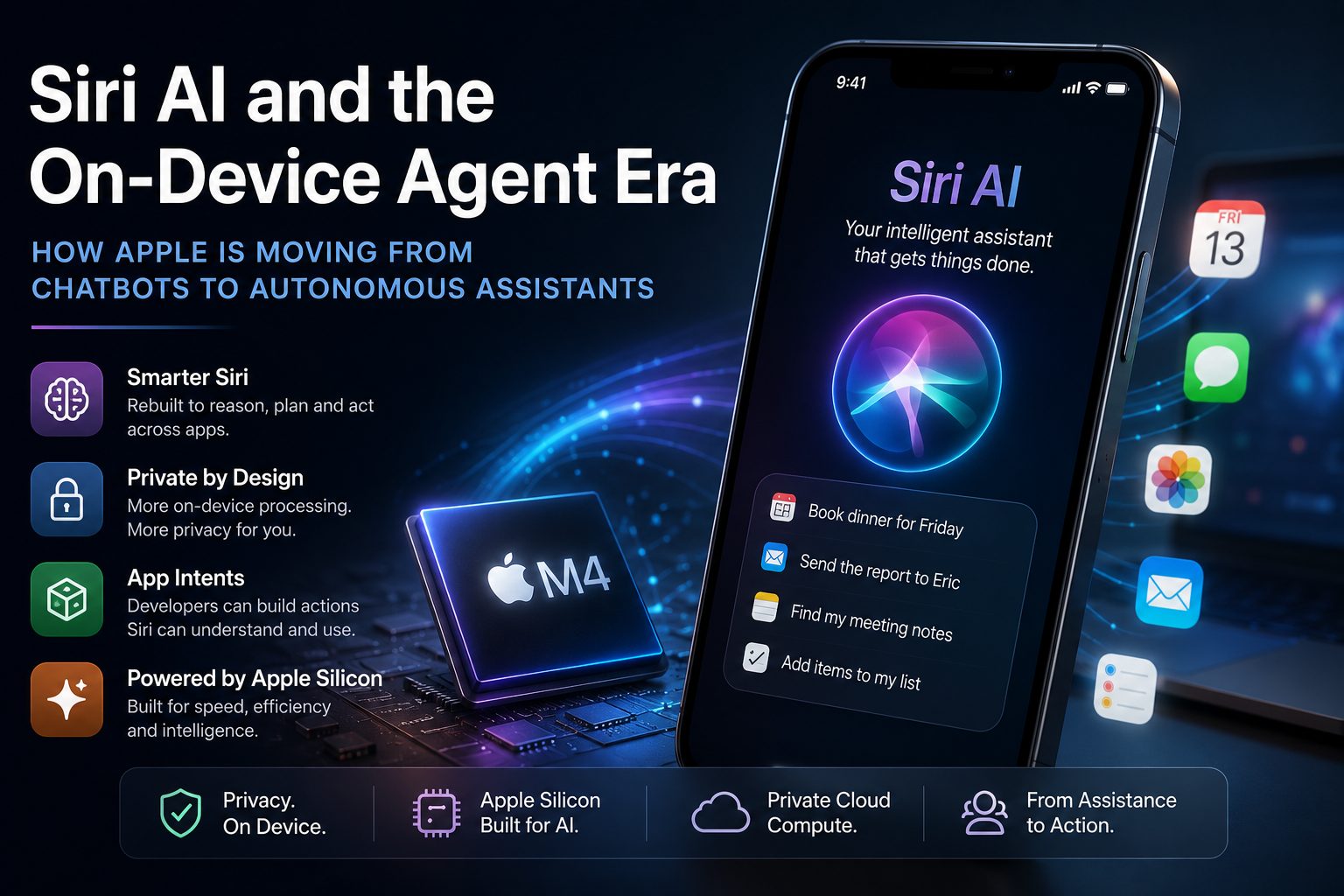
At WWDC 2026, held June 8 in Cupertino, Apple made its case for that shift. The company introduced Siri AI, a rebuilt version of its long-stagnant assistant, alongside a new generation of Apple Intelligence across iOS 27, iPadOS 27, macOS 27 (“Golden Gate”), watchOS 27, visionOS 27, and tvOS 27. Siri AI is designed to reason across apps, draw on personal context stored on the device, and carry out multi-step tasks — with much of that processing happening locally rather than in the cloud.
🔑 The most consequential piece of the announcement is one Apple didn’t put on a slide with much fanfare: Siri AI’s underlying models were built in partnership with Google, using Gemini technology. Understanding Apple’s new agent era means understanding both halves of that story.
It’s a genuine architectural shift for Apple, and also a more complicated story than “Apple goes all-in on private, on-device AI.”
1. From AI Assistants to AI Agents
It’s worth separating the categories of “AI” that have blurred together over the past few years.
- Traditional voice assistants — early Siri, Alexa, Google Assistant — handled narrow, single-turn commands: setting a timer, checking the weather. They had little memory and couldn’t chain actions together.
- LLM-powered chatbots (ChatGPT, Gemini, Claude) hold natural conversations and answer complex questions, but by default they don’t know what’s on your screen, what’s in your calendar, or which apps you have installed.
- AI copilots (Microsoft Copilot, GitHub Copilot) embed generative AI into a specific workflow — a document, an IDE — offering suggestions inside that context. They assist; they don’t usually take the lead.
- Autonomous agents go a step further: they can plan a sequence of steps, call on tools (apps, APIs, services) and carry a task through to completion with limited supervision.
Apple’s pitch for Siri AI is that it belongs in that last category, at the operating-system level — an agent with permissioned access to your apps and personal data, orchestrated by App Intents rather than confined to a single app.
2. What Siri AI Actually Is
Apple’s original Apple Intelligence, introduced in 2024, added system-wide writing tools, notification summaries, and image generation — but left Siri itself largely unchanged in capability. Two years and one well-publicized delay later, Siri AI is Apple’s attempt to deliver on that original promise.
What’s actually shipping or in beta as of mid-2026:
- A rebuilt Siri, in its own app. Siri AI now lives in a dedicated app, synced across iPhone, iPad, and Mac via iCloud, in addition to working system-wide. It can revisit earlier conversations, hold multi-turn exchanges, and — on a Mac — reason about what’s visible on screen.
- App Intents as the only path into third-party apps. Apple formally deprecated SiriKit at WWDC 2026, giving developers a two-to-three-year migration window. App Intents 2.0 is now the sole way Siri AI can act inside a third-party app, and it adds streaming responses, multi-turn follow-ups, and “on-screen awareness” so Siri can reference what a user is currently looking at. Apple’s own example of the resulting workflow: asking Siri to find photos a friend sent on a specific day, assemble them into a poster, and AirDrop it to a family member — a task that spans three separate apps, each exposing its own App Intents.
- Visual Intelligence, now built into the Camera app. A new “Siri” mode sits alongside Photo, Video, and Portrait in the Camera app. Point it at an object — a plate of food, a poster — and it can identify what it sees and take follow-up actions, such as splitting a restaurant bill. Object identification is powered by Google Image Search.
- An agentic Passwords app. Apple says the Passwords app can now act “agentically” on a user’s behalf, visiting websites individually to update compromised or weak passwords with a single tap.
- On-device and cloud foundation models. Apple says Siri AI relies on a new generation of Apple Foundation Models designed to support both on-device and server-based AI experiences. Apple has announced collaboration with Google on aspects of its AI stack.
This is a genuine rebuild of how Siri routes requests and accesses on-device data, not just a new coat of paint on the assistant. But it’s also, by Apple’s own account, a rebuild done with substantial help from a competitor’s AI technology.
3. On-Device AI, and Apple’s Bet on Google
Apple has long framed on-device processing as a privacy and latency advantage, and there are real technical reasons for that framing.
- Local inference cuts round-trip latency. A task handled entirely on-device — updating a contact card, summarizing a batch of notifications — doesn’t have to wait on a network round trip, which can make an assistant feel more responsive.
- Sensitive data can stay local for many tasks. Apple’s pitch is that health records, messages, and financial details can be processed without leaving the device for the on-device tier of Apple Intelligence, and that anything routed to Private Cloud Compute is handled in ephemeral, audited sessions that Apple has said it cannot access. Independent security researchers have reviewed Apple’s Private Cloud Compute architecture and its published transparency logs, though PCC’s real-world track record is still relatively new.
- Offline functionality is a genuine differentiator. Core agentic functions — scheduling, summarization, personal-context queries — are designed to work without a network connection, which most competing cloud-first assistants can’t match.
Where the story gets more complicated is the model layer itself. Apple’s public messaging emphasizes privacy, on-device processing, and Private Cloud Compute. At the same time, Apple has announced collaboration with Google on aspects of its AI stack. Independent reporting has suggested that some conversational capabilities may rely on Gemini-derived technologies, although Apple has not publicly disclosed the complete architecture or precisely how requests are routed between Apple’s own models and partner technologies. As a result, some implementation details remain outside the public record.
4. How the Agent Actually Works
An agentic assistant needs several capabilities working together: awareness of on-screen and cross-app context, a working memory of the current task, the ability to break a request into sub-tasks, and a permission system that keeps the user in control of sensitive actions.
Apple’s own example, drawn from its App Intents developer sessions, illustrates the intended workflow: a request to find photos from a specific person and day, assemble them into a poster, and share it — a chain that requires the Photos app, an editing or Image Playground surface, and Messages or AirDrop each to expose their own App Intents, with Siri AI coordinating the sequence and asking for confirmation at points where it’s taking a consequential action.
For anything involving sensitive data or an irreversible action — sending a message, making a purchase, accessing location — Apple has said the system will surface what it intends to do and require the user to approve, adjust, or cancel before proceeding. How well that permission system scales to more ambitious, multi-step requests than Apple’s own demos is something that will only be clear once Siri AI is broadly available; it’s a design goal Apple has stated, not yet a track record.
5. Apple vs. the Competition
Comparing Apple’s approach to the rest of the industry is complicated by the fact that Apple is now, in part, a Google customer as well as a competitor. With that caveat, here’s roughly where each major player stood as of mid-2026:
- OpenAI has pushed further into agentic products for both consumers and enterprises — including Operator, a browser-using agent, and Workspace Agents for ChatGPT Business and Enterprise customers, alongside GPT-5.5 as its flagship model. Its consumer products remain cloud-based by default.
- Google Gemini is both Apple’s most direct assistant competitor and, per Apple’s own APPLE FOUNDATION MODELS 3 disclosures, a technology supplier to Siri AI. Gemini is deeply integrated across Google’s own apps (Gmail, Calendar, Search) and has expanded agentic features of its own, including Gemini Enterprise for business customers.
- Microsoft Copilot remains focused on productivity and enterprise workflows, deeply embedded in Microsoft 365 and increasingly built out through Copilot Studio for building custom, guardrailed agents — a more structured, enterprise-governance-first approach than Apple’s or OpenAI’s.
- Samsung’s Galaxy AI takes a hybrid on-device/cloud approach on its own hardware, and — like Apple — has partnered with Google, using Gemini for several of its cloud-based features. This makes Samsung and Apple more similar in their underlying model supply chain than either company’s marketing tends to suggest.
- Meta AI remains largely cloud-based and is built around Meta’s own Llama models, integrated across Instagram, WhatsApp, and Facebook, with less emphasis on structured cross-app task automation than the other players here.
Apple’s genuine differentiation isn’t that it avoids large third-party models — it doesn’t. It’s the combination of on-device processing for a meaningful share of everyday tasks, a permission and audit layer Apple controls end to end, and deep integration into the operating system’s own data (Messages, Calendar, Photos, Contacts) that competitors without OS-level access can’t easily replicate.
6. Potential Benefits of the On-Device Agent Model
Some advantages of Apple’s approach are reasonably well supported by its architecture, even if their real-world impact will depend on execution:
- Reduced data exposure for on-device tasks. When a request can be handled entirely on-device, less data leaves the phone — narrowing, though not eliminating, the potential surface for a breach or misuse.
- Responsiveness for local tasks. On-device requests avoid network round-trip time, which can make everyday actions — checking a calendar, updating a contact — feel closer to instantaneous.
- Offline availability for core functions. A traveler without connectivity, or someone in a low-signal area, retains access to scheduling, summarization, and other on-device features that a purely cloud-based assistant would lose.
- A permission model users can inspect. Apple’s stated design — surfacing intended actions before executing sensitive ones — gives users a checkpoint that some more autonomous, browser-driving agents from other companies don’t consistently offer today.
Claims about cost savings or environmental benefits from shifting inference on-device are plausible in principle but weren’t part of Apple’s public disclosures at WWDC, so they’re left out here rather than stated as fact.
7. Challenges and Limitations
Apple’s approach faces real, unresolved constraints:
- Hardware fragmentation. iOS 27 itself installs on devices going back to the iPhone 11 — Apple’s widest release yet — but Apple Intelligence requires an iPhone 15 Pro or newer, and the most capable Siri AI features are limited to iPhone Air, iPhone 17 Pro, iPhone 17 Pro Max, iPad with M4 or later, and Mac with M3 or later, each with at least 12GB of unified memory. That leaves a large share of the active device base without access to the newest capabilities.
- Regional gaps at launch. Siri AI is not initially available in the European Union, where Apple has said it’s still working through regulatory requirements, or in China, for similar reasons. Both are large, important markets, and the timeline for availability there is not yet public.
- A compressed developer migration window. With SiriKit deprecated, developers who don’t adopt App Intents risk their apps becoming invisible to Siri AI — not broken, just silently absent from voice and agentic workflows. Apple has given a two-to-three-year support runway for SiriKit, but new development is expected to move to App Intents immediately, putting real near-term pressure on developer roadmaps.
- Smaller on-device models still have real limits. Even the larger 20-billion-parameter on-device tier is modest next to frontier cloud models, and Apple’s own fallback for harder requests depends on Private Cloud Compute connectivity and trust in Apple’s server-side guarantees.
- The Google dependency is a genuine complication for the privacy narrative. However the technical division of labor shakes out, Apple’s core AI capability now depends in part on technology developed by one of the companies it has spent years positioning itself against on privacy grounds. That’s not necessarily a problem for users, but it is a fact that complicates Apple’s own marketing.
- Agent errors carry higher stakes than chatbot errors. A wrong restaurant booking or a misdirected message has real-world consequences in a way a chatbot’s incorrect answer typically doesn’t. Apple’s permission system is designed to mitigate this, but it hasn’t yet been tested at scale.
8. Where This Could Go Next
The following are reasonable extrapolations from Apple’s stated direction, not confirmed roadmap items — Apple has not announced most of these as specific features:
- Deeper calendar automation that proactively suggests or reschedules based on stated preferences and past behavior
- Health-related pattern recognition (building on Apple’s existing HealthKit foundation) surfaced privately, with suggestions to consult a professional rather than a diagnosis
- Personal finance tracking that flags subscription creep or spending patterns, processed on-device
- Expanded smart-home orchestration that reduces reliance on cloud logging of routine sensor data
- Enterprise use cases — meeting prep, action-item summarization — that respect corporate data boundaries by design
Whether and how quickly any of this materializes will depend heavily on developer adoption of App Intents and on how well Apple’s permission system holds up as agentic requests get more ambitious.
9. Industry Impact
Apple’s shift toward an agentic OS has implications beyond its own product line.
For developers, the message is direct: apps that don’t expose App Intents risk being left out of Siri AI’s cross-app workflows entirely, even if they otherwise function normally. Migrating away from SiriKit is now a near-term priority rather than optional cleanup.
For competing platforms, Apple’s move adds pressure on Android and other ecosystems to demonstrate comparable on-device and cross-app capabilities of their own — a race that Google, notably, is fighting on two fronts simultaneously, as both Apple’s AI supplier and its most direct assistant competitor.
For enterprise and SaaS software, tools that can be orchestrated through structured actions rather than requiring a dedicated app experience may need to rethink how they stay relevant if AI assistants increasingly compose tasks across services on a user’s behalf.
For regulators, Apple’s data-minimization framing is likely to draw continued scrutiny in both directions — from privacy regulators assessing its claims, and from competition regulators examining a partnership between two of the largest technology companies in the world.
For chipmakers, sustained on-device inference keeps pressure on Qualcomm, and others to close the gap with Apple silicon’s Neural Engine performance, particularly on efficiency.
Conclusion
Siri AI is Apple’s most substantial attempt yet to move beyond conversational AI toward an assistant that can act on a user’s behalf — and after two years of delay, it’s a real, shipping product rather than a promise. The architecture genuinely does more processing on-device than most competing assistants, and Apple’s permission system gives users a level of visibility into agentic actions that isn’t universal across the industry.
At the same time, the full picture is more nuanced than “Apple’s private, on-device AI versus everyone else’s cloud AI.” Apple has acknowledged collaboration with Google on parts of its AI technology stack, although it has not publicly disclosed every architectural detail. As the platform evolves, understanding where Apple’s own technologies end and partner technologies begin will remain an area of interest for developers, analysts, and users alike.
❓ Frequently Asked Questions
What is Siri AI?
Siri AI is the rebuilt version of Apple’s assistant, introduced at WWDC 2026 alongside iOS 27. It’s designed to reason across apps, draw on personal context stored on-device, and complete multi-step tasks, and it’s available in a standalone app as well as system-wide.
Is Siri AI built entirely by Apple?
No. Apple has confirmed collaboration with Google on parts of its AI technology stack. Independent reporting has suggested that some conversational capabilities may incorporate Gemini-derived technologies, although Apple has not publicly described the complete technical architecture.
How does on-device processing protect privacy?
For tasks handled entirely on-device — using the roughly 3-billion or 20-billion-parameter Apple Foundation Models — data like messages, calendar events, and photos doesn’t need to leave the device. When a request is routed to Private Cloud Compute, Apple says that processing happens in ephemeral, isolated sessions it cannot access, though this claim rests on Apple’s own infrastructure and audit design.
What makes an AI agent different from a chatbot?
A chatbot responds to prompts one at a time. An agent — as Apple has designed Siri AI, via App Intents — can plan a sequence of steps, call on multiple apps as tools, and carry a multi-step task to completion with the user confirming sensitive actions along the way.
Will Siri AI work offline?
Apple has said core functions — scheduling, summarization, personal-context queries — run entirely on-device. Tasks that require live web data, such as checking prices or making a live booking, need connectivity.
Which devices support Siri AI?
Apple Intelligence broadly requires an iPhone 15 Pro or later, an M1 iPad or later, or an M-series Mac. The most capable Siri AI features are limited to iPhone Air, iPhone 17 Pro, iPhone 17 Pro Max, iPad with M4 or later, and Mac with M3 or later, each with at least 12GB of unified memory.
Is Siri AI available everywhere?
Not yet. Apple has said Siri AI is not available at launch in the European Union or in China while it works through regulatory requirements in each region.
Will Siri AI replace third-party apps?
Not directly. It relies on apps publishing App Intents to act as tools within its workflows. Apps that don’t adopt App Intents risk becoming invisible to Siri AI’s voice and agentic features, even though they continue to function normally when opened directly.
📌 Key Takeaways
Siri AI, announced at WWDC 2026, is a genuine architectural rebuild of Siri into an agentic assistant that can plan and execute multi-step tasks across apps via App Intents.
Apple has confirmed collaboration with Google on parts of its AI stack. Independent reporting suggests some conversational capabilities may use Gemini-derived technologies, although Apple has not publicly detailed the complete implementation.
SiriKit is deprecated in favor of App Intents 2.0; developers who don’t migrate risk their apps becoming invisible to Siri AI, on a two-to-three-year support runway.
The most capable features require recent, higher-end hardware (iPhone Air/17 Pro, M3+ Mac, M4+ iPad with 12GB RAM), and Siri AI isn’t available at launch in the EU or China.
Apple’s real differentiation is less “no big AI models” and more its on-device processing for everyday tasks, its permission system, and its deep integration with first-party app data.
📚 Sources
- • Apple Newsroom, “Apple unveils next generation of Apple Intelligence, Siri AI, and more” (June 8, 2026)
- • Apple Newsroom, “Apple aids app development with new intelligence frameworks and advanced tools” (June 2026)
- • Apple Developer, WWDC26 sessions on App Intents and Foundation Models
- • Apple Machine Learning Research, “Introducing Apple’s On-Device and Server Foundation Models”
- • CNBC, TechCrunch, Bloomberg, and Variety WWDC 2026 coverage (June 2026)