2026 Perspective
How AI and the
Developer Workflow
Are Merging
June 27, 2026
|
8 min read
|
AI · Development · Future of Work
✦ ✦ ✦
The Shift
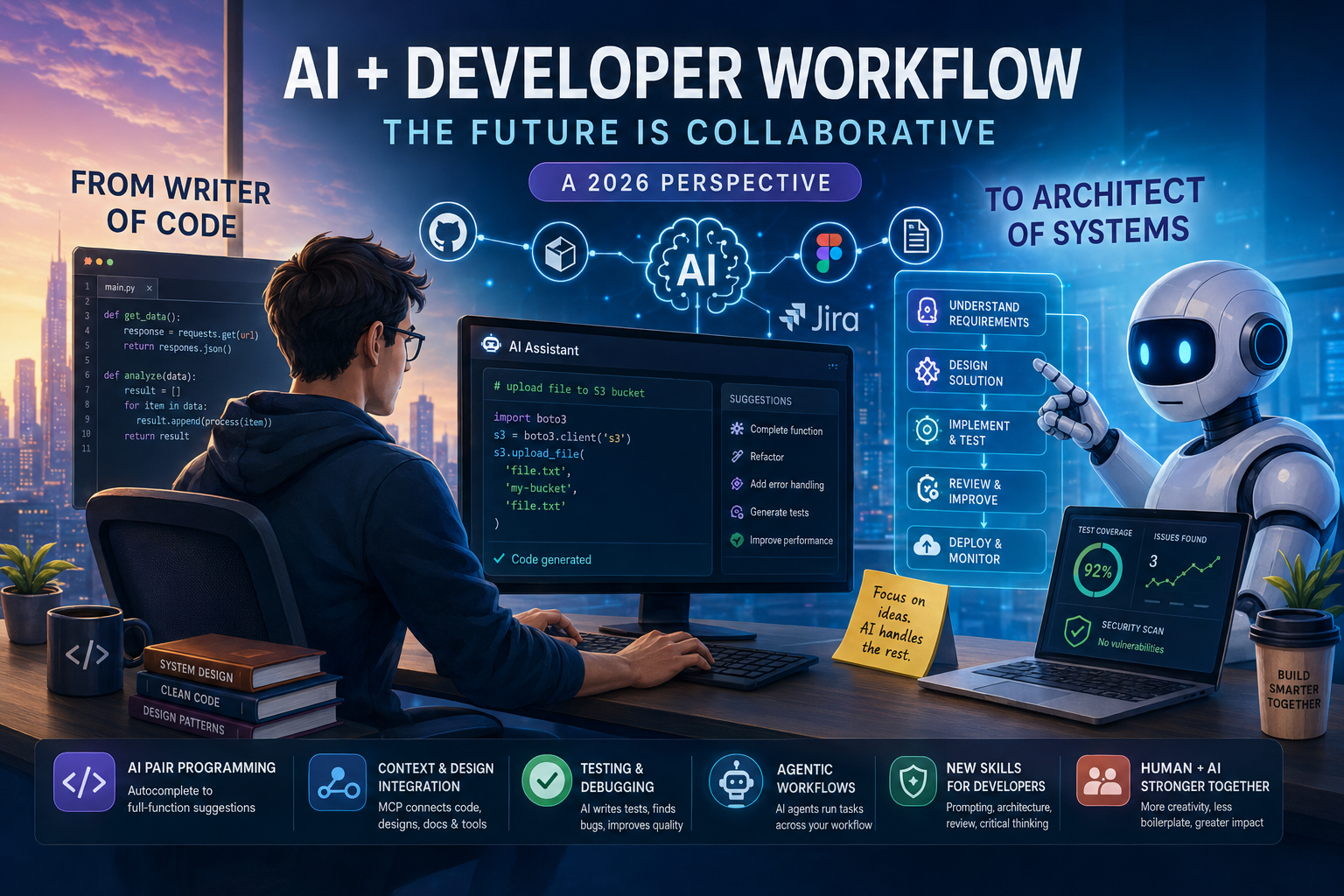
The archetypal image of a developer meticulously typing every line of code is rapidly becoming obsolete. The modern engineer is transitioning from a “writer of code” to an “architect and editor of systems.” AI-powered tools are now handling the routine, allowing developers to focus on higher-level tasks: defining intent, reviewing designs, and orchestrating the broader technical vision. As tools like Cursor articulate, today’s developer “shifts focus from writing code to directing AI agents.” This evolution isn’t about replacement; it’s about augmentation, enabling us to be more productive, creative, and strategic.
Phase 1: The Rise of the AI Pair Programmer
From Autocomplete to Full-Function Suggestions
The integration of AI into the Integrated Development Environment (IDE) has evolved from simple autocomplete to a sophisticated “AI pair programmer.” Pioneers like GitHub Copilot and Amazon’s Code Whisperer have become standard assistants, capable of suggesting entire functions or code blocks in real-time. Trained on billions of lines of code, these tools understand context and can generate precise API calls from natural-language comments. For example, a comment like “upload file to S3 bucket” can trigger the exact AWS code needed. As a result, developers spend significantly less time on syntax and routine tasks, allowing them to focus on logic and design.
Leading Tools Become Essential
What was once experimental is now integral to the development workflow. GitHub Copilot is a widely adopted “AI-powered assistant,” while newer tools like Cursor are pushing the boundaries further. Cursor treats AI as a built-in agent, indexing entire codebases to provide hyper-relevant, context-aware suggestions. It automates repetitive tasks and even handles multi-file modifications. The impact on productivity is tangible: one study found that teams using Cursor merged 39% more pull requests. By offloading boilerplate and routine coding, developers gain valuable time to design systems, debate trade-offs, and refine product vision.
Phase 2: Beyond Code Generation (The New Frontiers)
By 2026, AI’s role extends well beyond code completion, branching into design integration, testing, and autonomous task execution.
Context & Design (Model Context Protocol)
A pivotal advancement is the Model Context Protocol (MCP), an open standard that connects AI assistants directly to other tools in your workflow. This means your AI can access not just your code, but also design files, issue trackers, and documentation. With MCP, GitHub Copilot can pull design context from Figma or fetch requirement details from a Jira ticket this transforms AI from a guessing machine into a fully-informed peer programmer. For instance, a single prompt can now result in a complete feature implementation by reading the Jira spec and Figma mockups, drastically improving accuracy and alignment with project goals.
Testing & Debugging
AI is also revolutionizing quality assurance. Tools like Copilot Testing enable developers to generate unit tests with a simple prompt. The AI writes tests, runs them, detects failures, and iterates until everything passes, summarizing coverage and changes for easy review. On the debugging front, AI-driven code reviews are now mature. These systems scan for syntax issues, logic errors, and security vulnerabilities. For example, AWS Code Whisperer includes built-in security scanning to identify and fix leaks like exposed keys. AI is not just writing code—it’s also checking it, closing the loop for faster, more reliable development.
Agentic Workflows
The most exciting frontier is the rise of agentic AI—tools that can autonomously carry out complex, multi-step tasks. Cursor, for instance, allows developers to delegate entire features to an AI agent that can execute shell commands, modify multiple files, and demo the final result. On GitHub, similar agents can run tests, fix backlog issues, or manage releases with minimal human intervention. This evolution positions developers as conductors rather than typists. By triggering an AI agent to refactor a legacy module or update dependencies, the team can move faster while retaining final decision-making authority.
The New Skill Set for Developers
As AI handles routine coding, the skills that define a great developer are changing. The emphasis is shifting from syntax mastery to strategic thinking.
- Prompt Engineering: Writing clear, unambiguous prompts is now a foundational skill. The quality of AI output is directly tied to the quality of the input. A well-crafted prompt is the difference between a useful solution and a waste of time.
- System Design & Architecture: With low-level coding automated, a deep understanding of the big picture is paramount. Developers must possess strong architectural insight—understanding how modules fit together and evaluating performance, security, and trade-offs—as AI is not yet reliable for high-level design.
- Code Review & Quality Assurance: The increase in AI-generated code makes robust review skills more critical than ever. Developers must be vigilant for logic errors, edge cases, and security vulnerabilities, validating and refining AI suggestions with a sharp human eye.
- Critical Thinking & Problem Solving: AI excels at familiar patterns and fully-specified tasks, but humans remain superior for novel, ambiguous problems. The developer’s core role is to define the right problems, evaluate AI-generated solutions, and provide creative oversight.
Challenges and Pitfalls to Avoid
This AI-driven future comes with risks that require careful management.
Security & Data Privacy
AI tools often process code on external servers, raising concerns about proprietary information. There is a risk of exposing secrets like API keys. Teams must enforce strict policies, such as not allowing AI to scan unreleased code and always reviewing output for unintended information disclosure.
Code Quality & Technical Debt
AI-generated code can be buggy or inconsistent, and over-reliance may lead to accumulated technical debt. AI tools can hallucinate APIs or use deprecated libraries. Treat AI output as a draft—always test, profile, and refactor it. Do not accept suggestions blindly.
The Skill Gap
Junior developers who lean too heavily on AI may miss out on learning fundamental concepts. To counteract this, encourage a culture of learning. Require developers to explain AI-generated code before merging, and use AI suggestions as teaching opportunities to ensure the technology augments, rather than replaces, core skills.
Looking Ahead (The Future State)
In the near future, imagine a development team where humans and AI agents are true partners. Developers spend less time on plumbing and more time defining goals and strategies. AI agents fetch data, generate code, and run tests autonomously. Architects set system requirements and constraints, while AI implements standard modules. The developer becomes an orchestra conductor—focusing on the melody of user experience and product vision, while the AI instruments handle the repetitive notes.
This shift is already being predicted. Experts note that the human role is evolving into “orchestrating AI systems,” with an emphasis on maintaining the big picture and strategic oversight. We may see new roles emerge, like prompt specialists, but the core of the team will remain human judgment—deciding what to build, ensuring quality, and caring for the end-user.
Ultimately, AI is poised to amplify developer productivity and creativity, not eliminate it. Teams that embrace this partnership will combine human ingenuity with AI efficiency, building software that is faster, smarter, and more impactful than ever.
How are you integrating AI into your daily workflow?
Share your experiences and favorite tools in the comments below!
Published with for the dev community