🤖 Future of Work • AI in 2026
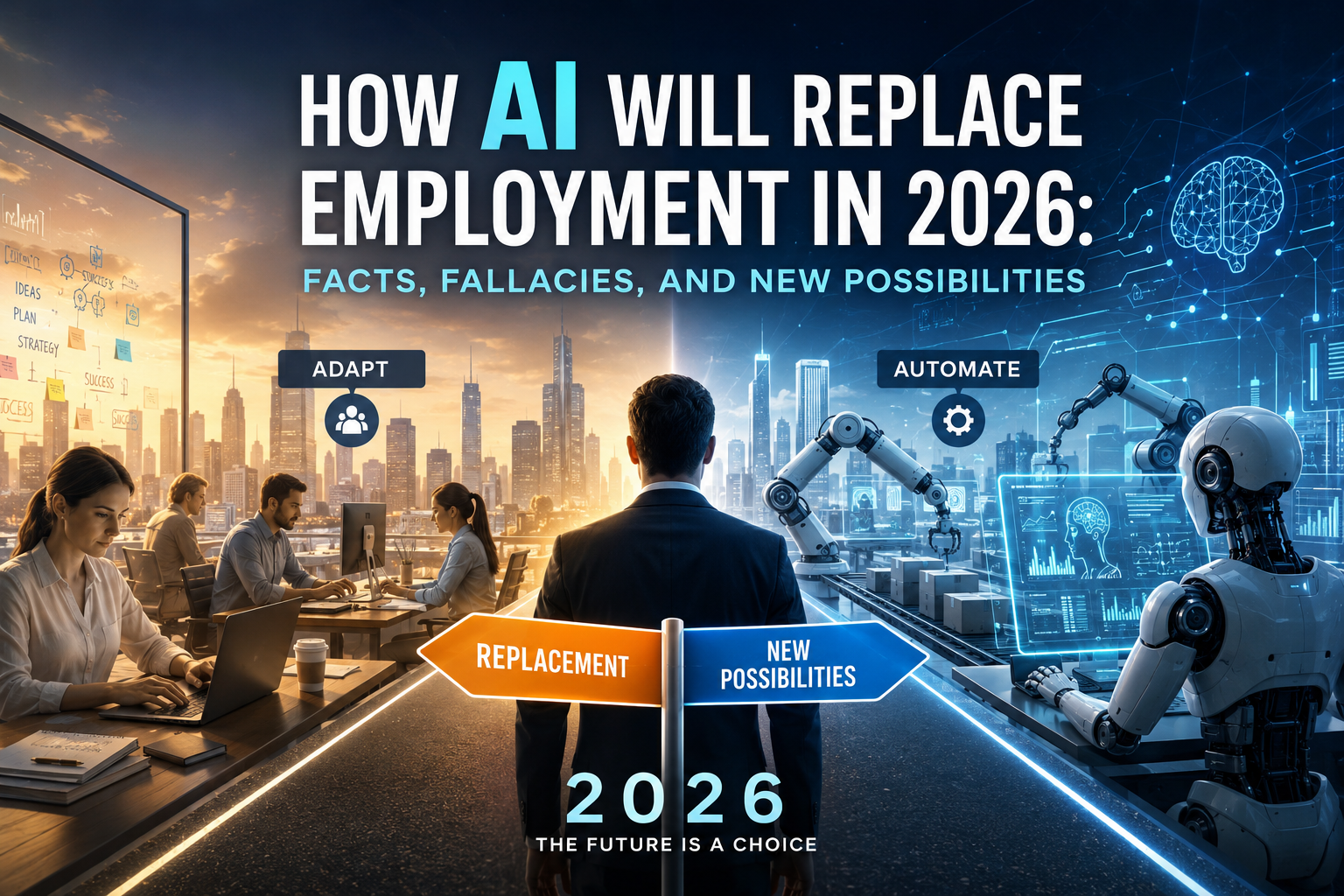
How AI Will Replace Employment in 2026:
Facts, Fallacies, and New Possibilities
Artificial intelligence is transforming industries faster than ever.
Discover what jobs are truly changing, which fears are myths, and
how humans can thrive alongside AI in 2026.
Introduction: The AI Employment Revolution
Artificial intelligence is no longer a futuristic concept in 2026.
Both our everyday lives and our workplaces now involve AI systems.
Businesses worldwide are adopting automation tools to improve speed,
reduce costs, and increase efficiency.
Everyone is discussing how AI will replace human labor. However, the
reality is more complex than the headlines suggest. This article explains
the facts, clears up the myths, and highlights the exciting new
opportunities emerging in the AI-powered economy.
The Real Story of AI and Employment Replacement
AI Excels at Repetitive Tasks
AI systems are highly effective at handling repetitive work.
Data entry, simple customer support, scheduling meetings,
organizing emails, and generating reports can now be completed
within seconds using automation tools.
Jobs Are Changing — Not Disappearing Overnight
In manufacturing, AI-powered robots work alongside humans to
handle dangerous or repetitive duties. In offices, AI software
automates routine paperwork. Most professions are evolving rather
than completely disappearing.
Common Myths About AI Taking Over Jobs
❌ Myth 1: AI Will Replace Every Human Job
This is false. AI is a tool, not a full replacement for human intelligence.
Jobs requiring creativity, emotional intelligence, leadership, and complex
decision-making remain deeply human.
❌ Myth 2: Only Low-Skill Jobs Are at Risk
AI is also reshaping high-skill professions. Lawyers use AI for document
analysis, and doctors use AI-assisted diagnostics. The real factor is whether
the task is routine and predictable.
❌ Myth 3: The Change Will Happen Instantly
AI adoption is gradual. Businesses need time to integrate systems,
and employees need time to learn new skills. 2026 is part of a long-term
transformation process.
New Opportunities Created by AI in 2026
🧠 AI Management & Supervision
AI systems require human oversight. Roles like AI Trainers, AI Ethicists,
and Machine Learning Managers are rapidly expanding across industries.
🤝 Human-AI Collaboration
Many future careers involve working directly with AI tools.
Marketing AI specialists, AI-assisted designers, and productivity
strategists combine human creativity with machine intelligence.
🔧 Technical Support & Security
AI systems need maintenance, upgrades, and cybersecurity protection.
This creates strong demand for technicians and security professionals.
❤️ Human-Centered Careers
As AI handles repetitive work, society places greater value on empathy,
creativity, coaching, caregiving, and mental health services.
Skills You Need to Thrive in the AI Era
💻 Digital Literacy
Learn how to use AI tools effectively in your field.
🧩 Critical Thinking
Analyze information and make strategic decisions beyond automation.
😊 Emotional Intelligence
Empathy, teamwork, and communication remain uniquely human strengths.
📈 Adaptability
Continuous learning is the most valuable career skill in 2026.
🚀 You do not need to be a computer genius.
You simply need to be willing to learn and adapt.
How to Future-Proof Your Career
1. Audit Your Tasks
Identify which parts of your work are repetitive and which require
judgment, communication, and creativity. Focus on strengthening
the human side of your profession.
2. Upskill Regularly
Take online courses and learn the AI tools used in your industry.
Many valuable resources are affordable or even free.
3. Embrace AI as a Partner
Use AI tools as assistants rather than seeing them as enemies.
Professionals who know how to work with AI will become more valuable.
Conclusion: A Future of Collaboration, Not Replacement
The story of AI in 2026 is not simply about job loss.
It is a story of transformation. While some tasks and roles
are disappearing, many more opportunities are emerging.
The key to success is adaptability. By learning new skills,
embracing technology, and focusing on uniquely human strengths,
people can thrive in the AI-powered future.