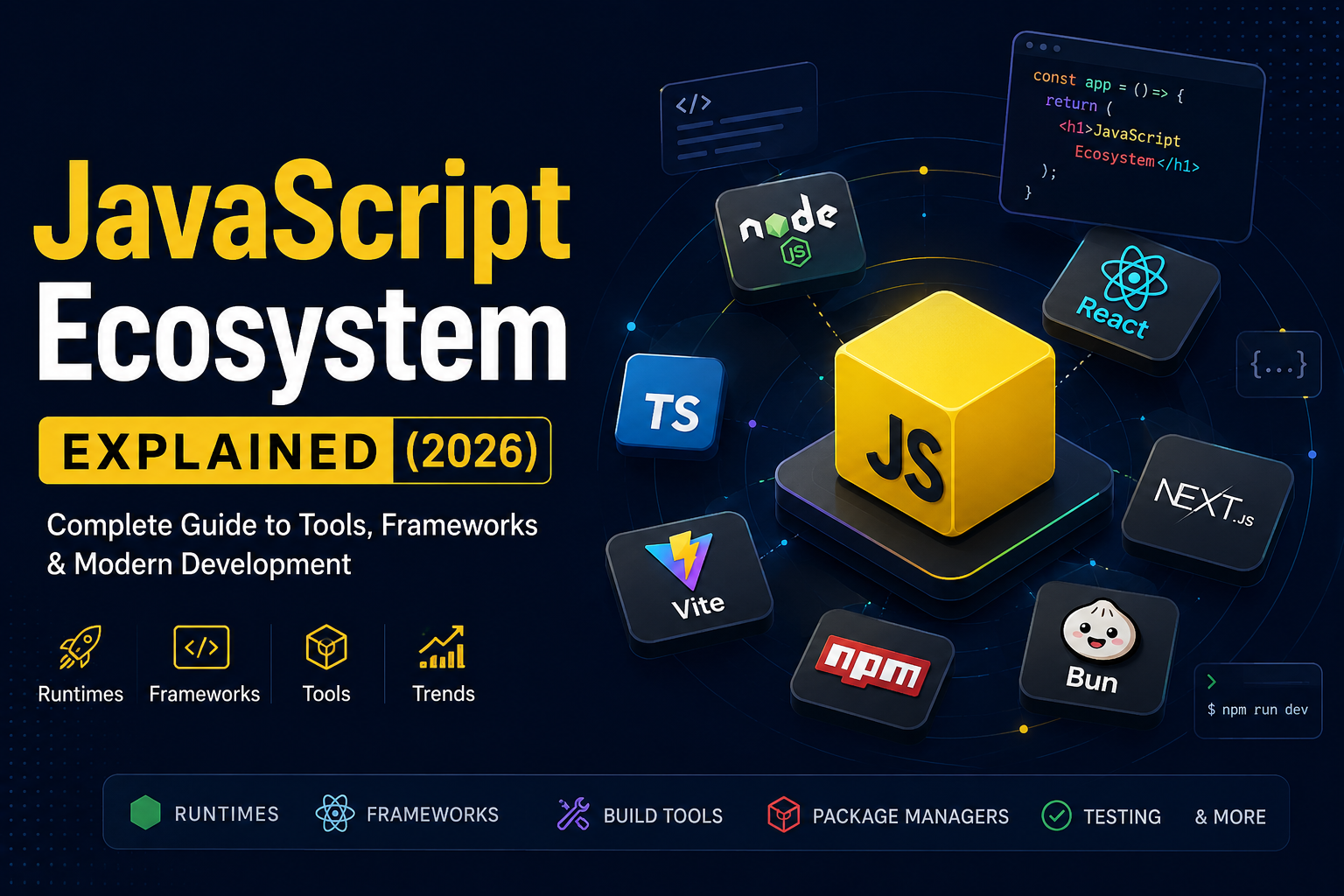
JavaScript Ecosystem Explained (2026)
Complete Guide to Tools, Frameworks & Modern Development
Welcome to the sprawling, dynamic, and sometimes overwhelming world of the JavaScript ecosystem. What began in 1995 as a 10‑day project to add simple interactivity has evolved into the most widely used programming language on the planet. Today, JavaScript powers everything from tiny marketing sites to Netflix, Uber, and Airbnb.
This guide is your map. We’ll demystify the tools, frameworks, and runtimes that make up the modern JavaScript ecosystem, helping you navigate from beginner to confident professional.
🌳 What Is the JavaScript Ecosystem?
Imagine a rainforest: towering canopies (frameworks), rich soil (runtimes), pollinators (package managers), and decomposers (build tools). The ecosystem includes everything needed to write, test, deploy, and maintain JavaScript apps.
- The Soil (Runtime): Node.js, Deno, Bun – where code lives and runs.
- The Roots (Package Managers): npm, Yarn, pnpm – pull in libraries.
- The Plants (Frameworks/Libraries): React, Vue, Angular – visible structures.
- The Gardeners (Build Tools): Vite, Webpack – bundle & optimize.
⚙️ The Core Components of the JavaScript Ecosystem
1. JavaScript Runtime Environments
| Runtime | Release Year | Key Features | Best For |
|---|---|---|---|
| Browser Engines (V8, SpiderMonkey) | 1995-2008 | DOM access, Web APIs, event loop | Client-side interactivity |
| Node.js | 2009 | Mature npm, event-driven | Backend APIs, CLIs |
| Deno | 2020 | Secure by default, TypeScript-native | Serverless, security-critical |
| Bun | 2022 | All-in-one, blazing fast | High-performance scripts, full-stack |
Expert Tip: Start with Node.js for job market, then explore Bun for speed.
2. Package Management
npm (largest registry), Yarn (deterministic lockfiles), pnpm (disk space efficient & strict).
- ✅ Always commit
package-lock.jsonoryarn.lock. - ✅ Use
npm cion CI servers. - ✅ Run
npm auditregularly.
3. Frontend Frameworks and Libraries
| Framework/Library | Primary Use | Philosophy | Learning Curve | Job Market |
|---|---|---|---|---|
| React | SPAs, React Native | Component-based, JSX | Medium | Massive |
| Vue.js | SPAs, progressive apps | Approachable, SFC | Low | Growing |
| Angular | Enterprise apps | TypeScript-first, MVC | High | Strong |
| Svelte | High‑performance SPAs | Compile-time, no virtual DOM | Low | Niche but rising |
When to choose: React for flexibility & cross-platform; Vue for gentle learning; Angular for large enterprise; Svelte for minimal bundle size.
4. Backend Development (Server‑Side JS)
Express.js (minimalist), NestJS (enterprise, TypeScript), Fastify (speed + schema validation).
// Simple API with Express (5 lines)
const express = require('express');
const app = express();
app.get('/api/hello', (req, res) => res.json({ message: 'Hello Ecosystem!' }));
app.listen(3000);
5. Full‑Stack Frameworks (Meta‑Frameworks)
Next.js (React SSR/SSG), Nuxt.js (Vue), Remix (web fundamentals), Astro (zero JS by default, islands architecture). Avoid over‑engineering: for blogs, Astro > Next.js SSR.
6. Build Tools & Bundlers
Vite (lightning fast HMR), Webpack (veteran), esbuild (Go‑powered), Rollup (library-focused). Vite is the modern default.
7. Testing Ecosystem
- Unit: Jest / Vitest (Vite native).
- Component: Testing Library (a11y-first).
- E2E: Cypress, Playwright (reliable auto‑waits).
🏢 How JavaScript Powers Modern Applications
| Company | How They Use JS | Key Benefit |
|---|---|---|
| Netflix | Node.js for SSR | 70% faster startup |
| Airbnb | React + React Native | 90% code reuse |
| Uber | Node.js microservices | Millions of concurrent trips |
| Spotify | React + service workers | Offline playback |
✨ Sharing logic (validation, types) between frontend & backend is a killer feature.
📈 Current Trends in the JavaScript Ecosystem (2026)
- AI Integration: LangChain.js, Transformers.js running ML models in-browser.
- Edge Computing: Cloudflare Workers, Vercel Edge → sub‑20ms latency.
- TypeScript standardization: New frameworks built with TS.
- WebAssembly (Wasm): high‑performance code (Figma, video editing).
- DX Revolution: Zero‑config Vite, Biome, Turborepo.
⚠️ Challenges & Criticisms (With Solutions)
| Challenge | Why It Hurts | Practical Solution |
|---|---|---|
| Framework Fatigue | Constant churn | Stick to React/Next.js or Vue/Nuxt – stable & funded. |
| Rapid Ecosystem Changes | Breaking updates | Dependabot + integration tests. |
| Security Concerns | Supply chain attacks | npm audit, socket.dev, smaller maintained packages. |
| Dependency Hell | Massive node_modules | pnpm + ES modules for tree shaking. |
🗺️ Best Learning Path for New Developers
Variables, functions, loops → build a to‑do list with prompt/alert.
querySelector, events → dark mode toggle, click counter.
Arrow functions, destructuring, async/await, modules → fetch API data.
Run JS outside browser, file system CLI.
Start with React (job market) or Vue → component shopping cart.
Express + PostgreSQL/MongoDB → REST API for todos.
Next.js / Nuxt blog with authentication.
Vitest + Playwright → deploy to Vercel/Fly.io.
🎯 Total: ~5‑6 months of consistent practice to feel job‑ready.
🔮 Future of the JavaScript Ecosystem (5‑Year Predictions)
- TypeScript becomes default – plain JS feels “legacy”.
- Runtimes converge (Node.js adopts Deno/Bun features).
- Serverless‑first mindset & edge middleware standard.
- AI‑assisted development (Copilot‑level boilerplate generation).
- Wasm libraries for high‑performance tasks (image processing, video).
❓ Frequently Asked Questions (FAQ)
📌 Conclusion
The JavaScript ecosystem is vast, vibrant, and empowering. With modern runtimes, frameworks, and tooling, you can build full‑stack, real‑time, AI‑powered apps from a single codebase. Remember: master vanilla JS first, choose stable combos (React/Next or Vue/Nuxt), embrace TypeScript, and keep learning core principles.
📘 Continue your journey: interactive challenges, Node.js microservices & React hooks deep‑dive.
© 2026 JavaScript Ecosystem Guide — Modern Web Development insights. All trademarks belong to their respective owners.