
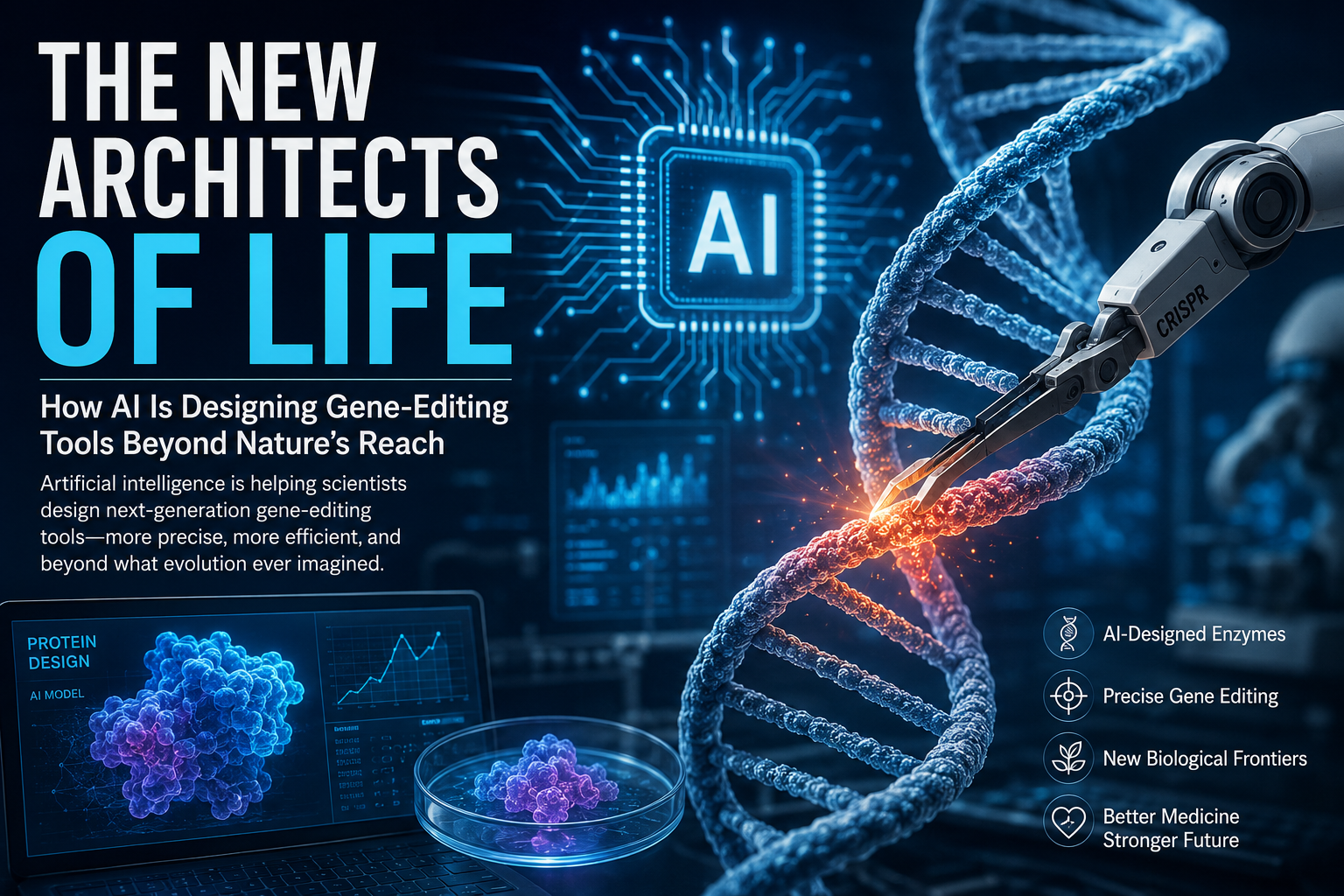
The New Architects of Life: How AI Is Designing Gene-Editing Tools Beyond Nature’s Reach
“Recent advances in artificial intelligence and protein engineering have enabled researchers to design novel biological molecules, including CRISPR-related tools. While these AI-designed systems are still being evaluated, they represent a major step toward creating gene-editing technologies beyond naturally occurring enzymes.”
“Much like CRISPR democratized the ability to edit DNA at will,” says molecular biologist Soeren Lienkamp, “AI-based protein design promises to allow anyone to create totally novel properties in the protein space”.
This convergence of AI and gene editing represents a paradigm shift. For the first time, we are not merely borrowing from nature’s toolbox—we are building our own. The implications for medicine, agriculture, and biotechnology are profound.
Nature’s Blueprint, Reimagined
To understand why this matters, it helps to understand what CRISPR is—and what it isn’t.
CRISPR-Cas systems evolved in bacteria as a defense mechanism against viruses. When scientists harnessed these systems for gene editing, they effectively repurposed microbial immune systems for human use. The most common tool, Cas9 from Streptococcus pyogenes (SpCas9), works well but has limitations: it can cause unintended off-target edits, varies in efficiency across cell types, and is constrained by evolutionary boundaries.
For years, scientists tried to improve CRISPR through directed evolution and structure-guided mutagenesis—tweaking natural proteins to enhance specific properties. But evolution is a stubborn designer. “Once you start tweaking things, you realize pretty quickly that while you can make changes, they ultimately produce something that isn’t functional,” says Doudna.
AI has changed that calculus entirely.
How AI Learns to Design Biology
The new generation of AI models can identify complex patterns in biological data, helping researchers predict and design proteins with desired properties.
Protein language models represent a breakthrough approach. Just as ChatGPT learns the patterns of human language, these models are trained on vast datasets of protein sequences to learn the “language” of amino acids. The Pro fluent team, for instance, trained their model on more than 1 million CRISPR operons—the genetic units that encode CRISPR systems—mined from 26 terabases of genomic data. The model learned to generate entirely new CRISPR-Cas proteins, some of which are 400 mutations away from any known natural protein.
Inverse folding models take a different approach. Instead of predicting structure from sequence, they work backwards—designing amino acid sequences that will fold into a desired 3D structure. This is the core of Doudna’s breakthrough. Her team defined which parts of the TnpB protein needed to remain fixed based on evolutionary constraints, then used inverse folding models to redesign the variable regions.
Diffusion models, similar to those used in AI image generation, are also making their mark. These models iteratively refine protein structures from random noise, creating designs that incorporate complex constraint. As John Ingraham, head of machine learning at Generate Biomedicines, explains: “It’s not about how do I make the final thing; it’s about how do I make small changes that make it better”.
The result is a multi-pronged approach to protein design—sequence-based, structure-based, and hybrid methods working in concert.
Beyond Imitation: AI That Surpasses Nature
“Recent studies in AI-driven protein design demonstrate the potential of this approach, showing that machine-learning models can generate novel protein sequences that require experimental testing to determine their biological function.” They focused on TnpB, a tiny CRISPR-Cas12-like nuclease that serves as an evolutionary precursor to the more complex Cas12.
Researchers are exploring hybrid AI approaches that combine evolutionary information, protein structure prediction, and generative models to design new protein variants, including potential CRISPR-associated enzymes.”. Some AI-designed proteins have shown substantial sequence differences from naturally occurring proteins while maintaining or improving desired biological properties, although each candidate requires laboratory validation.
“Early research suggests that AI-designed nucleases can sometimes achieve promising activity levels, but extensive testing is required before they can match or replace established gene-editing tools.” Cryo-electron microscopy revealed that the engineered proteins had formed new, stable interactions at the RNA-DNA interface. They weren’t just copying nature—they were improving upon it.
The approach was hybrid in another sense too. The researchers split the design process, separately designing variants of the DNA-binding interface and the guide RNA–binding interface, then combining the best candidates from each approach. This modular strategy allowed them to explore combinations that evolution had never tested.
AI as a Gene-Editing Copilot
Beyond designing new enzymes, AI is transforming how scientists plan and execute gene-editing experiments.
CRISPR-GPT is one such tool. Developed by researchers at Stanford Medicine, it acts as a gene-editing “copilot” that helps scientists design experiments, analyze data, and troubleshoot problems. Trained on 11 years of expert discussions and published scientific literature, the AI responds like an experienced lab mate.
Early demonstrations suggest that AI assistants like CRISPR-GPT may help researchers plan experiments, interpret results, and reduce errors during gene-editing workflows.
“The hope is that CRISPR-GPT will help us develop new drugs in months, instead of years,” says Le Cong, the senior author of the study.
The AI system is designed to provide guidance at different levels of technical understanding, although practical gene editing still requires specialized laboratory knowledge and training It can also predict off-target edits and suggest experimental approaches that might otherwise be overlooked.
Responsible AI systems for biology increasingly incorporate safety measures designed to reduce misuse risks, although no safeguard system can eliminate all potential concerns.
The CRISPR-ATLAS: A New Resource
A key enabling factor behind these advances is the sheer scale of data now available. Large-scale CRISPR databases and genomic resources have expanded researchers’ ability to study microbial genetic diversity and discover new CRISPR-associated systems. These resources contain millions of biological sequences and provide valuable training data for AI models, although they serve different purposes from broader protein databases such as UniProt.
This data abundance changes what’s possible. The Atlas enabled researchers to fine-tune language models to generate CRISPR-Cas proteins with remarkable diversity. AI models can generate large numbers of candidate protein sequences, allowing researchers to explore regions of protein space that may differ significantly from known natural examples.
“We release OpenCRISPR-1,” the Profluent team announced, “to facilitate broad, ethical use across research and commercial applications”. This AI-designed gene editor is being made freely available—a gesture that echoes the early CRISPR community’s commitment to open science.
From Lab to Field: Real-World Applications
The implications of AI-designed biology span multiple domains.
Medicine and Gene Therapy: AI-designed nucleases could lead to more precise, more efficient gene therapies with fewer off-target effects. The ability to tailor enzymes to specific therapeutic needs—rather than relying on naturally occurring variants—could accelerate the development of treatments for genetic diseases. As Esaín-Garcia notes, “We live in a world where we’re moving towards personalized medicine, and we think the possibility of being able to create [enzymes with] your own tailored properties are very important for that”.
Agriculture: AI-guided genome editing is accelerating the development of climate-resilient, high-yield, and disease-resistant crops. Machine learning models can predict optimal gene targets and guide RNA designs, reducing the trial-and-error that has slowed plant breeding. One study successfully used AI-driven predictive modeling with CRISPR/Cas9 to identify and edit yield-related genes in rice, resulting in improved grain size and stress resilience.
Synthetic Biology: Generative AI can design proteins for entirely new applications—from therapeutic antibodies to enzymes for bioremediation. The field is moving from modifying existing proteins to building them de novo, from the ground up.
The Risks We Cannot Ignore
For all its promise, AI-designed biology raises profound concerns.
Off-target Effects: Gene editing can cause unintended DNA modifications, including chromosomal translocations, large deletions, and even chromothripsis—a catastrophic fragmentation of chromosomes. Sensitive sequencing studies have revealed that genome editing can sometimes cause unexpected genetic changes, including large deletions and chromosomal rearrangements, depending on the editing method and biological context.
Biosecurity: The democratization of gene editing is a double-edged sword. AI models that design biological sequences could potentially be misused to create harmful agents. Compounding this risk, generative AI can “paraphrase” protein sequences—generating novel variants that are similar enough to be functional but different enough to evade detection by current screening methods.
Access and Equity: Advanced AI-guided gene editing technologies are concentrated in wealthy institutions, potentially excluding researchers and communities in low-resource settings. This raises questions about fairness and the potential for unequal access to new therapies and crop improvements.
Regulatory Gaps: Current regulatory frameworks are fragmented and often outdated. National Institutes of Health recombinant DNA guidelines, for instance, trail behind the EU’s Advanced Therapy Medicinal Product framework. There’s no global harmonization for low- and middle-income countries, and bio surveillance infrastructure remains inadequate.
Human Genome Modification: Ethical debates around editing the human germline—changes that would be passed to future generations—remain unresolved. The introduction of AI-designed enzymes adds new layers of complexity to these discussions.
A Path Forward
Researchers and policymakers are beginning to address these challenges.
The integration of AI-based sequence screening could strengthen biosecurity, flagging potentially dangerous sequences before they’re synthesized. International organizations and governments are increasingly developing frameworks for AI governance, including discussions around responsible AI use, transparency, and biological safety, represents an effort to promote international cooperation in AI governance.
CRISPR-GPT’s built-in safeguards—rejecting requests for editing human embryos or viruses—offer a template for responsible AI deployment. But broader solutions will require coordinated international action: harmonized screening standards, global biosafety registries, and ethical frameworks that can keep pace with rapid technological change.
A New Era of Creation
What makes this moment transformative is the scale and speed of what’s becoming possible.
Where directed evolution might explore a few thousand variants over years, AI can generate millions of protein sequences in days. Where rational design depended on detailed structural knowledge, protein language models can learn functional constraints without explicit mechanistic hypotheses.
“We’re seeing an AI revolution in every field,” says protein designer Noelia Ferruz. “I guess it’s the perfect moment”.
AI-designed biological tools developed in current research may not represent the final form of future gene editing, but they demonstrate the growing ability to engineer biological systems with greater precision. But the principle they demonstrate is profound: AI allows researchers to explore biological designs that may not have been discovered through natural evolution alone. We can design biology with properties evolution never produced, tailored to needs evolution never anticipated.
The question is not whether this technology will transform medicine, agriculture, and biotechnology. It will. The question is whether we will manage it wisely.
As David Baker of the University of Washington has observed: “It’s always hard to predict the future. I’ve always said that, and it’s only getting truer”.
What is clear is that AI has become a partner in the oldest human endeavor: shaping the living world to meet our needs. This is a metaphor and works well as a conclusion.