
AI Agents in 2026: How Autonomous AI Is Transforming Work, Business, and Daily Life
Introduction
The year is 2026, and the landscape of technology has dramatically shifted. What once seemed like science fiction is now an integral part of our reality: AI agents. These aren’t just advanced algorithms; they are autonomous entities capable of understanding, reasoning, and acting independently to achieve specific goals.
From streamlining complex business operations to enhancing our personal lives, AI agents are no longer a futuristic concept but a present-day phenomenon. This blog explores how these intelligent systems are transforming work, business, and everyday life.
The Rise of Autonomous AI Agents: A 2026 Perspective
In 2026, AI agents are far more advanced than traditional chatbots or automation tools. They can plan strategies, execute multi-step tasks, learn from feedback, and adapt to changing environments.
Advances in large language models, reinforcement learning, and real-time data processing have accelerated their adoption across industries, making AI agents essential digital collaborators.
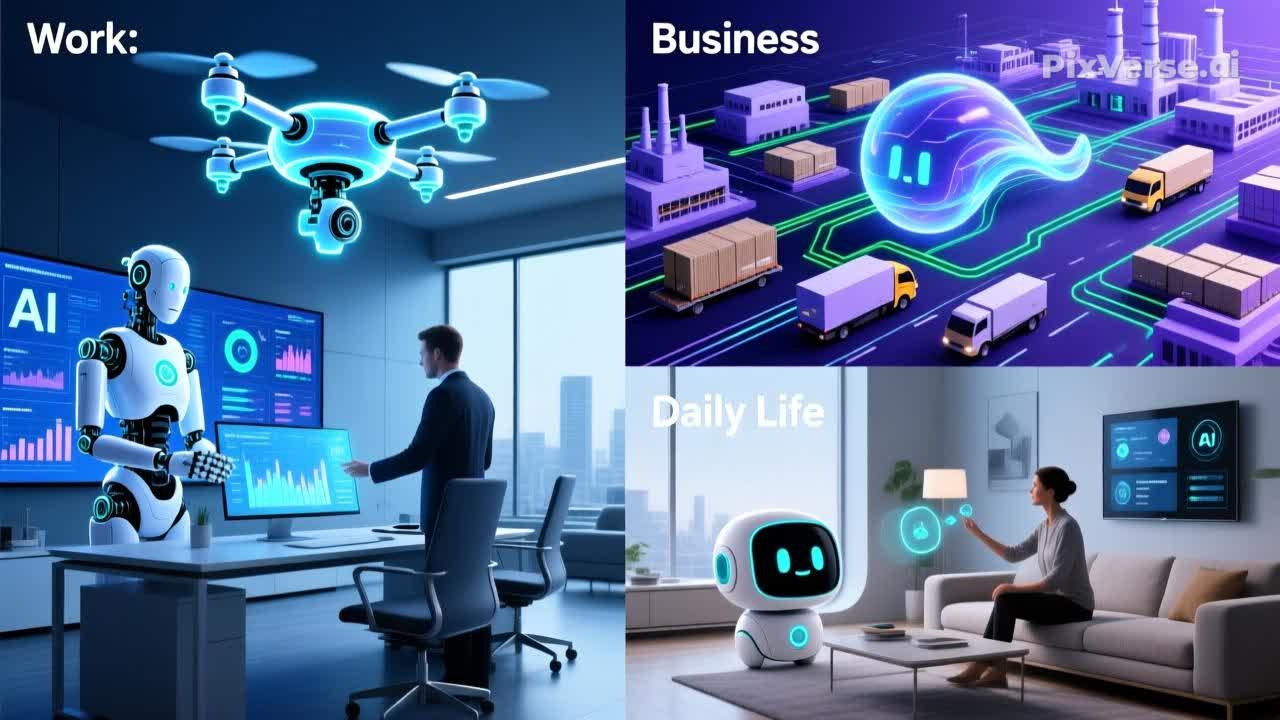
Transforming the World of Work
Automation of Complex Tasks
AI agents excel at automating complex, multi-layered processes. In finance, they analyze market data, predict trends, and manage portfolios. In supply chains, they forecast disruptions and optimize logistics in real time.
Legal and administrative AI agents process thousands of documents, extract insights, and draft reports, allowing professionals to focus on high-value strategic work.
Augmenting Human Capabilities
Rather than replacing humans, AI agents often enhance human productivity. They assist with research, data synthesis, and report generation while offering personalized learning recommendations to employees.
This allows people to focus on creativity, leadership, and critical thinking — areas where human judgment remains essential.
Reshaping Job Roles and the Workforce
New roles such as AI Agent Managers and Prompt Engineers are emerging. These professionals design, guide, and monitor AI agents to ensure optimal performance.
While automation affects repetitive jobs, it also creates opportunities for skilled workers who can collaborate effectively with AI systems.
Revolutionizing Business Operations and Strategy
Enhanced Efficiency and Productivity
AI agents are transforming customer service by handling complex queries and predicting customer needs. Operations teams use agents for resource planning, inventory management, and production optimization.
Marketing and sales AI agents personalize campaigns, analyze customer behavior, and optimize conversion funnels in real time.
Data-Driven Decision Making at Scale
AI agents continuously analyze massive datasets to detect trends, forecast demand, and guide strategic decisions. Businesses now rely on real-time insights rather than historical reports.
These agents also play a crucial role in fraud detection, cybersecurity, and risk assessment.
Innovation and New Business Models
AI agents accelerate innovation by assisting in product design, simulation, and testing. The rise of Agent-as-a-Service models allows companies to access specialized AI agents without heavy infrastructure investments.
Integrating into Daily Life: Personal AI Agents
Personalized Assistants Beyond Smartphones
Personal AI agents manage schedules, finances, and health data autonomously. Integrated with smart homes, they adjust lighting, temperature, and security based on habits and preferences.
They can anticipate needs, optimize energy usage, and even manage grocery lists automatically.
Education and Skill Development
In education, AI agents serve as adaptive tutors, customizing learning paths and identifying knowledge gaps. They make education more personalized, accessible, and efficient.
Entertainment and Creativity
AI agents collaborate creatively by composing music, assisting writers, and generating artwork. They also curate entertainment experiences tailored to individual preferences.
Challenges and Ethical Considerations in 2026
Security and Privacy
AI agents handle sensitive personal and business data, making strong security, encryption, and ethical data policies essential.
Bias and Fairness
Bias in training data can lead to unfair outcomes. Continuous monitoring, transparency, and ethical AI practices are necessary to ensure fairness.
Accountability and Regulation
Determining responsibility when AI agents make mistakes is complex. Governments and organizations are developing regulatory frameworks to balance innovation and public safety.
The Road Ahead: What’s Next for AI Agents?
AI agents will become more generalized, capable of collaborating in networks known as swarm intelligence. Their integration with physical robotics will further blur the line between digital and physical automation.
As innovation continues, maintaining ethical standards and human-centered design will be critical in shaping a balanced AI-driven future.





2 Comments
Потрясающая статья, совсем вчера вечером
копался по такому теме.
Спасибо за тёплые слова! 🙏
Рада, что информация была полезной. Буду рада видеть вас снова на сайте.