Multimodal AI in Healthcare 2026: How Med-Gemini Is Redefining Medical Diagnostics
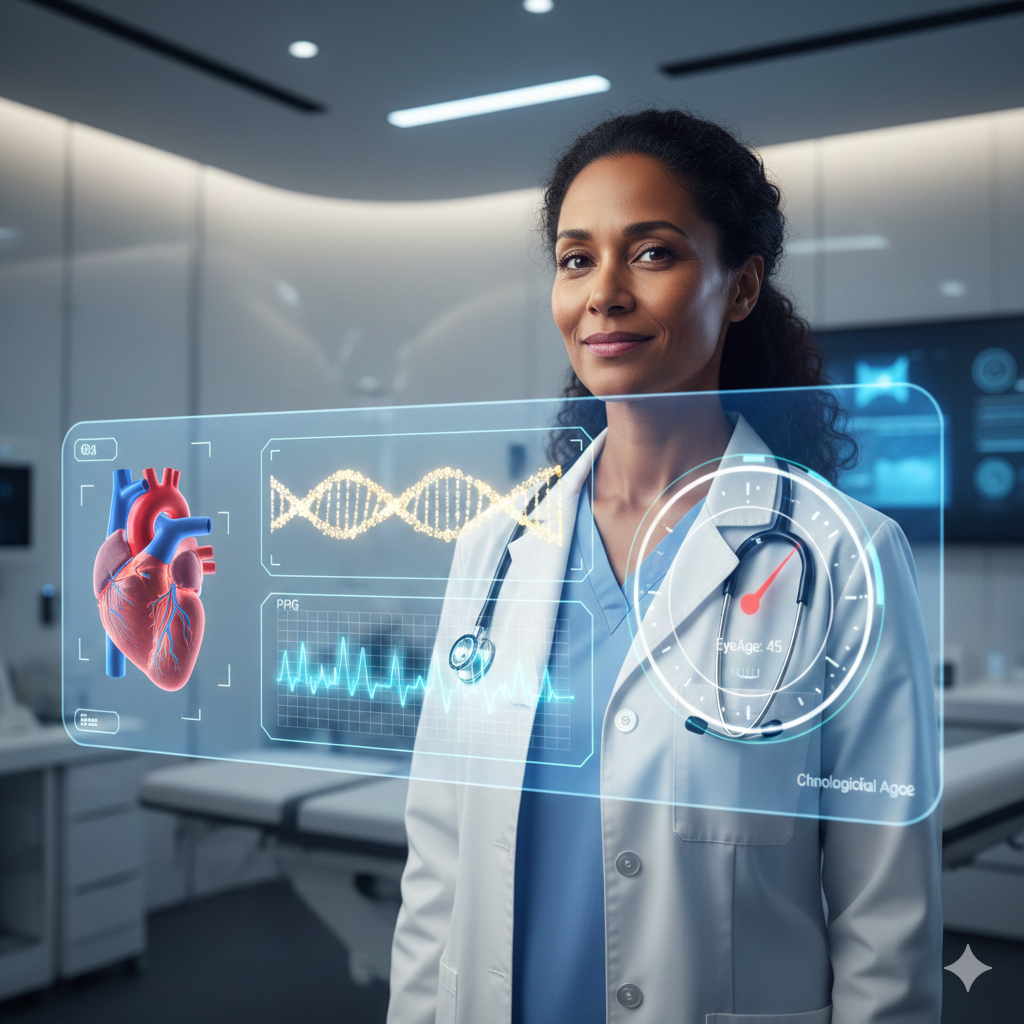
'/%3E%3Ccircle cx='800' cy='250' r='140' fill='%23ffffff10'/%3E%3Ccircle cx='200' cy='400' r='180' fill='%23ffffff08'/%3E%3Cpath d='M350 230 L500 230 L500 380 L350 380 Z' fill='none' stroke='%23ffffff40' stroke-width='2' /%3E%3Ccircle cx='425' cy='305' r='35' fill='%23999' /%3E%3Cpath d='M425 280 Q500 210 620 230' stroke='%23fbbf24' stroke-width='4' fill='none' /%3E%3Ctext x='380' y='250' fill='%23ffffff' font-size='14' font-family='Arial'%3E3D CT%3C/text%3E%3Ctext x='650' y='200' fill='%23ffffff' font-size='16' font-family='Arial'%3E🧬 DNA%3C/text%3E%3Ctext x='850' y='350' fill='%23ffffff' font-size='14' font-family='Arial'%3E📱 PPG%3C/text%3E%3Ctext x='200' y='180' fill='%23ffffff' font-size='24' font-family='Arial' font-weight='bold'%3EMed-Gemini%3C/text%3E%3Ctext x='200' y='250' fill='%23e0f2fe' font-size='16' font-family='Arial'%3Emultimodal AI%3C/text%3E%3C/svg%3E "Med-Gemini AI: Physician Analyzing Multimodal Patient Data in Futuristic Clinic")
Multimodal AI in Healthcare 2026:
How Med-Gemini Is Redefining Medical Diagnostics
•
Updated March 2026
•
8 min read
Why Multimodal AI Matters for Modern Healthcare
Multimodal AI in healthcare refers to systems capable of interpreting and reasoning across diverse data sources simultaneously—medical imaging, genomic sequences, electronic health records, and even consumer device data. This mirrors the way clinicians think: integrating a patient’s symptoms, lab results, imaging studies, and history to form a complete diagnostic picture.
For healthcare providers, understanding this shift is critical. As patients increasingly use AI‑powered search to find care, optimizing for these systems becomes a competitive necessity.
1. Redefining Medical Imaging and Automated Reporting
Medical imaging has long been a cornerstone of diagnosis, but interpretation remains time‑intensive. Med‑Gemini is changing this by automating and enhancing the entire reporting process, representing a major advance in deep learning medical imaging.
📄 2D Radiology Breakthroughs
Med-Gemini-2D has set new performance standards for chest X‑ray (CXR) reporting. In expert evaluations, for normal cases between 57% and 96% of its reports were rated as “equivalent or better” than those written by radiologists. This demonstrates an ability not just to identify anomalies, but to articulate their absence with human‑like clarity.
🧠 First-Ever 3D CT Interpretation
Med-Gemini-3D is the first LMM capable of end‑to‑end report generation for 3D computed tomography (CT) volumes. By treating depth as a sequential dimension, the model navigates complex volumetric scans—a breakthrough that could dramatically reduce diagnostic delays in overstretched health systems.
⚕️ Comprehensive Clinical Reasoning
Unlike previous models that only identified objective findings, Med‑Gemini generates both the “Findings” and “Impression” sections of a radiology report. It synthesizes observations to communicate their inferred clinical significance—the essential information needed for patient management decisions.
2. AI in Genomic Discovery: Unlocking Life’s Blueprint
Simultaneously, machine learning is revolutionizing our understanding of the human genome, moving beyond traditional methods to uncover the intricate genetic roots of disease.
🔬 The Deep Null Framework
Traditional Genome‑Wide Association Studies (GWAS) often assume linear relationships—a simplification that may not reflect biological reality. The Deep Null framework uses deep neural networks to model non‑linear covariate effects, increasing the statistical power of genetic variant identification by up to 20% without sacrificing accuracy.
🧬 Unsupervised Learning with M-REGLE
Frameworks like REGLE and M‑REGLE pioneer the use of high‑dimensional clinical data (HDCD)—such as Spirograms and ECG/PPG signals—for genetic discovery without expensive expert labels. M‑REGLE uses early fusion to learn joint representations across multiple data types—a form of multi‑omics data integration—discovering significantly more genetic loci than traditional unimodal methods (19.3% more for 12‑lead ECG data).
📊 Phenotyping at Scale
Machine learning models can now classify medical images to identify “cardinal end phenotypes,” such as the vertical cup‑to‑disc ratio (VCDR) for glaucoma. This automated analysis has led to the discovery of 93 novel genetic associations, opening new avenues for understanding and treating the condition.
3. Personalized Risk Assessment via Everyday Technology
One of the most promising applications is the migration of diagnostic power from clinical equipment to the consumer devices already in our pockets.
📱 Smartphone-Based Cardiovascular Screening
Research demonstrates that photoplethysmography (PPG) sensors—already in most smartphones—can be repurposed for deep learning. The Deep Learning Score (DLS) predicts the 10‑year probability of major adverse cardiovascular events (MACE) as accurately as traditional scores requiring physical measurements like BMI and blood pressure. This breakthrough in cardiovascular risk assessment AI could turn a routine smartphone interaction into a life‑saving health check.
⏳ The Retinal Aging Clock
By applying deep learning to retinal fundus images, researchers have developed “eyeAge”—a biological aging clock with granularity of less than a year. When eyeAge accelerates beyond chronological age, it serves as a non‑invasive marker for the onset of age‑related diseases and overall mortality risk. It offers a literal window into the body’s true state of aging.
How to Optimize Healthcare AI Content for Search
For healthcare marketers covering AI in medicine, Google’s Search Generative Experience (SGE) prioritizes content that demonstrates Experience, Expertise, Authoritativeness, Trustworthiness (E‑E‑A‑T).
| Strategy | Implementation | Benefit |
|---|---|---|
| Structured Content | Clear headings, bullets, tables | Higher AI citation rates |
| Multimodal Assets | Images/video with alt text | Improved multimodal search |
| Cite Sources | Peer‑reviewed studies | Strengthens E‑E‑A‑T |
| Expert Authorship | Credentialed author bios | Builds trust |
High‑value keywords used in this article: artificial intelligence in healthcare, machine learning diagnostics, deep learning medical imaging, genetic variant identification, multi‑omics data integration, cardiovascular risk assessment AI, AI‑powered personalized medicine.
Conclusion: From Benchmarks to Bedside
While the potential for Med‑Gemini and related AI frameworks is vast, researchers emphasize the critical importance of closing the gap between static benchmarks and real‑world clinical utility. The ultimate goal is not to replace human specialists—whose expertise, empathy, and intuition remain irreplaceable—but to create integrated systems where AI works alongside clinicians.
Imagine a future where AI helps triage 3D scans in real‑time, discovers hidden genetic links to disease, and alerts a young person to future cardiac risk via their smartphone—years before symptoms appear. This is the true promise of the multimodal revolution: a future where AI‑powered personalized medicine becomes the standard of care.
Frequently Asked Questions
What is multimodal AI in healthcare?
Multimodal AI refers to artificial intelligence systems capable of processing and reasoning across multiple types of medical data simultaneously—including imaging, genomic sequences, and sensor data—to support clinical decision‑making.
How is Med-Gemini different from previous medical AI?
Unlike earlier models focused on single tasks, Med‑Gemini is a Large Multimodal Model that can interpret 2D X‑rays, 3D CT volumes, and generate comprehensive clinical reports including both findings and impressions.
Can AI really predict heart disease from a smartphone?
Yes. Research shows that deep learning applied to PPG sensors (in most smartphones) can predict 10‑year cardiovascular risk as accurately as traditional clinical scores requiring physical measurements.
Is AI going to replace doctors?
No. The goal of medical AI is to augment human expertise, not replace it. These tools are designed to reduce diagnostic delays and allow clinicians to focus on patient care.